
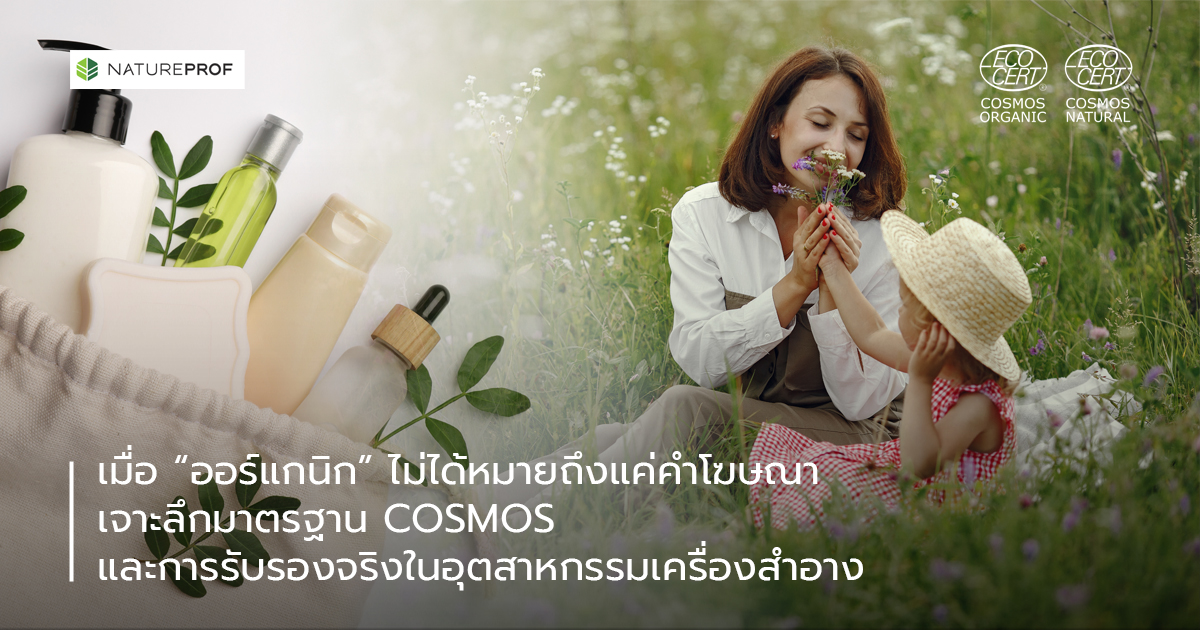
“Organic” More Than a Buzzword, It’s a Verifiable Standard
In recent years, the word “organic” has become a key selling point for beauty products around the world. Many consumers are now choosing cosmetics that are natural, safe, and sustainable. At the same time, however, the market is full of products that use the word “organic” in a vague way. Sometimes, just a small amount of natural extract is highlighted and promoted as the main selling point.
Image name : When “Organic” Is More Than Just a Marketing Claim : A Deep Dive into the COSMOS Standard and Real Certification in the Cosmetics Industry
This article will help you gain a deeper understanding of what truly qualifies as an “organic cosmetic,” what it has to go through, and why the COSMOS standard is a key indicator of transparency in this industry. We will also share real examples from NatureProf – one of the few factories in Thailand that can manufacture and fully prepare products for COSMOS certification.
Common Misconceptions About “Organic Cosmetics”
Many brands use the words “organic” or “natural” without explaining “to what level it is organic.” For example:
● They use only plant extracts, but not from certified organic agriculture.
● They have some natural ingredients but still use preservatives or base ingredients derived from petrochemicals.
● They advertise “chemical-free,” which is scientifically incorrect, because even water and air have chemical structures.
All of this leads to “greenwashing” – exaggerated or misleading communication that causes consumers to misunderstand the product.
NatureProf clearly sees this problem in the Thai market, and we always try to educate brand owners that “being organic” must be based on international standards that can truly be audited – not just on verbal claims.
What Is the COSMOS Standard?
COSMOS (Cosmetic Organic and Natural Standard) is a joint standard established by five leading European organizations: ECOCERT, Soil Association, Cosmébio, ICEA, and BDIH, created to form a common baseline so that the word “organic” in cosmetics has the same meaning worldwide.
COSMOS has three main objectives:
- Protect consumers through transparent, verifiable information.
- Protect the environment by promoting sustainable production processes.
- Strengthen industry credibility through audits conducted by independent certification bodies.
Types of COSMOS Certification
- COSMOS ORGANIC – Uses agricultural ingredients that meet the criteria for organic content (at least 95% of agricultural ingredients must be organic, and at least 20% of the total formula must be organic).
- COSMOS NATURAL – Focuses on 100% natural ingredients. Even if the organic percentage is not high enough, the formula must not contain prohibited substances.
- COSMOS APPROVED / CERTIFIED INGREDIENT – For raw materials that are approved for use in cosmetic formulas seeking certification.
Put simply, COSMOS checks everything from “the origin of raw materials” all the way to “the finished product on the shelf.”
Key Criteria That Make COSMOS Different
Instead of going deeply into complex calculation formulas, let’s focus on the core principles that consumers and brand owners should know:
1. Raw Materials Must Be Fully Traceable
Every ingredient must have documentation confirming its cultivation source, processing method, and organic or natural certification.
2. Manufacturing Processes Must Be Environmentally Friendly
Manufacturing should use techniques such as:
● Cold press extraction
● Steam distillation
● Supercritical CO₂ extraction
3. High-Risk Chemicals Are Not Allowed
For example:
● PEG derivatives
● Silicones
● Parabens
● Phenoxyethanol
● Nanomaterials
4. A Robust Quality Management System Is Required
The manufacturer must have documentation such as:
● Product Information File (PIF)
● Raw Material Questionnaire (RMQ)
These documents ensure that every step can be fully traced back and verified.
5. Packaging Must Be Sustainable and Recyclable
The use of new (virgin) plastic must be reduced, and preference given to reusable, recyclable, or renewable materials.
A Simple Example :
“Contains Organic Extracts” ≠ “Is an Organic Cosmetic”
If your lotion contains only 2% organic coconut oil, while the rest of the formula is conventional synthetic ingredients, that does not qualify as an “organic cosmetic.”
On the other hand, if that lotion uses organic ingredients making up more than 20% of the total formula, and is manufactured under COSMOS standards, then you can correctly claim “COSMOS ORGANIC.”
Why Should Brand Owners Work With a Factory That Can Support COSMOS Certification?
Manufacturing organic cosmetics is not just about the “formula.” It involves the entire factory system, including:
● Production rooms
● Equipment cleaning procedures
● Raw material storage
● Documentation and record-keeping
All of these must align with the inspection criteria of the certification body.
At NatureProf, we are one of the few factories in Thailand that already have robust systems in place – documentation, production management, and full traceability – to support COSMOS certification in an end-to-end manner.
In addition, NatureProf has a team of experts in international cosmetic regulations and European documentation systems (EU PIF & MoCRA). This helps brand owners prepare complete dossiers before submission, which makes the entire process faster and reduces the risk of mistakes.
How COSMOS Certification Supports Your Brand Strategically
1. Builds International Credibility
Products certified under COSMOS can be placed on shelves in regions such as Europe, Japan, and Australia.
2. Increases Brand Value and Customer Loyalty
New-generation consumers value transparency more than advertising claims.
3. Reduces Legal and Reputational Risks
Claiming “organic” without evidence can lead to scrutiny and damage your brand’s credibility.
4. Supports ESG and the Green Economy
COSMOS certification contributes directly to your organization’s environmental and sustainability goals.
Image name : When “Organic” Is More Than Just a Marketing Claim : A Deep Dive into the COSMOS Standard and Real Certification in the Cosmetics Industry
Key Lessons NatureProf Wants Brands to Understand
“Organic cosmetics” are not just a fashion trend. They represent a production philosophy that respects both the user and the planet.
NatureProf is therefore not only a manufacturer, but also a technical partner that educates clients – from ingredient selection and documentation, to developing communication strategies that align with legal and factual requirements.
Examples of how we have supported clients include:
● Developing an organic sunscreen formula using non-nano zinc oxide that truly meets COSMOS criteria.
● Developing a 98% natural shampoo using coconut-derived surfactants (coco-glucoside) and preservatives that are allowed on the COSMOS positive list.
● Providing consulting for obtaining COSMOS APPROVED status for Thai herbal extracts intended for the European market.
True Beauty Begins With the Right Understanding
The word “organic” cannot be measured from just one or two ingredients. It reflects the entire system that shows how seriously the brand and manufacturer take safety, transparency, and sustainability.
As a professional manufacturer, NatureProf believes that educating consumers is a key mission of this industry. The right understanding helps uplift the whole market and elevate the image of Thai brands on the global stage.
Image name : When “Organic” Is More Than Just a Marketing Claim : A Deep Dive into the COSMOS Standard and Real Certification in the Cosmetics Industry
NatureProf (OEM / ODM manufacturer) :
“We are committed not only to producing quality products, but also to creating new understanding within the beauty industry.” — NatureProf’s team of experts in manufacturing and COSMOS standards